Investments Based on Net Worth
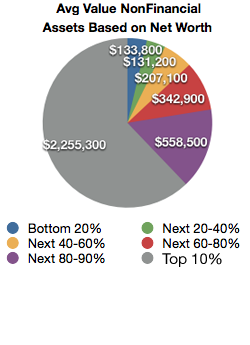
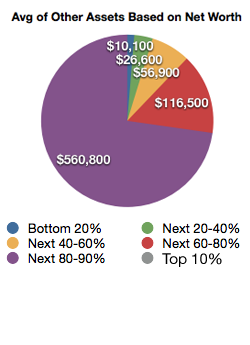
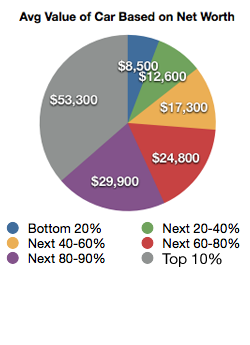
Since I brought up how much people spend on their home based on Net Worth I’ll now cover how much is held in other investments.
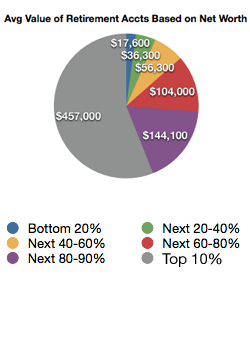
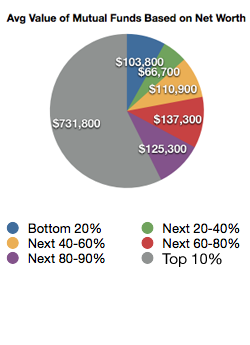
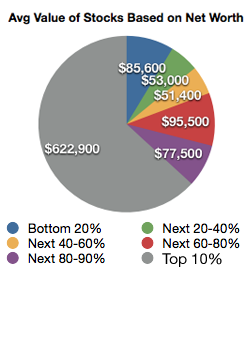
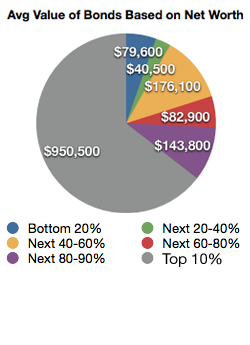
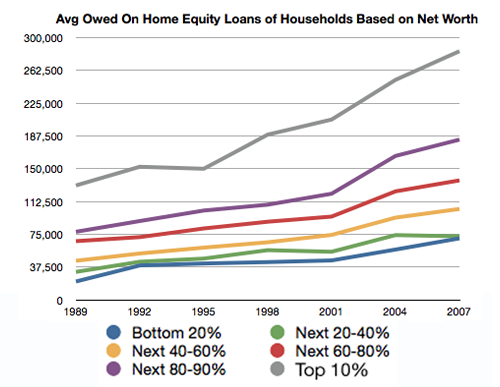
Net Worth and Debt
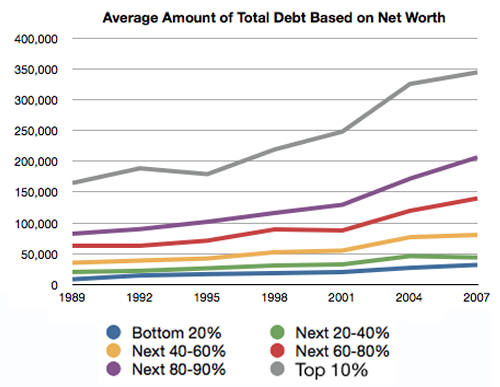
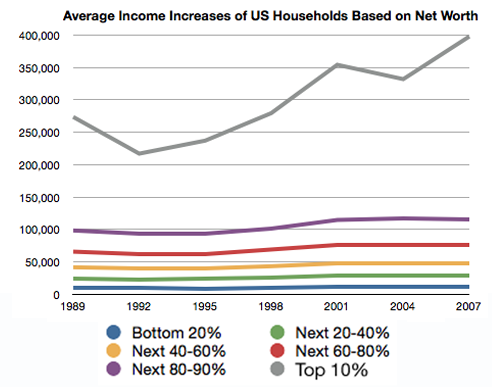
Just because people make a lot of money doesn’t mean they don’t spend it. As you’ll see below the wealthiest owe a great deal to creditors. I’ll touch on income a bit here, but will leave much of that data for the next article.

That’s All Folks
Well that is pretty much all there is to know about the subject of the Average Net Worth of Americans. In 2012 a new Federal Reserve Boards Survey of Consumer Finances will come out. We’ll then be able to see where we are based on current data. I don’t think it will be pretty.
In up coming articles I’ll cover Income in America and more on the elite 1%.
Leave questions or comments below.
If you liked this article please like it on Facebook or click the Google +1 button to the right.
Till Next Time
Great work
I’m working with another person to develop a website that encourages folks to “make a video, make a difference”. The website is designed to precipitate videos that will inform the public of the maldistribution of wealth (and closely related topics). I was surprised to discover the current distribution and Norton and Ariely research convinced me I was not alone in my “ignorance”. I plan to use some “sample” videos on the website to serve as examples. With your permission I’ll use some of yours. If you are interested I can also keep you informed of the progress of out site.
Thanks
Jake
It sounds like a good idea. You can do whatever you’d like with my videos.
I just made this video because I saw biased information coming out from both the right and the left. I only used 2 government sources being the Federal Reserve Boards Survey of Consumer Finances and IRS Tax Stat data.
I’m glad you found it enlightening 🙂
Net worth = your assets (your savings, your investments, the value of your home) minus your liabilities (your debts). I wonder what is the average net worth of Americans who are debtors versus Americans who are not debtors? It is a very important distinction. Someone who earns a 6 figure income, but has a jumbo mortgage would be in the bottom 25%, based on your data. Someone who earns $10 an hour but has a paid off home mortgage and a home valued at $130K would be in the 50 to 75%. Taxing “the wealthy” will simply translate into taxing low to middle income people who choose to stay out of debt in order to bail out high income people who borrow too much to finance a lifestyle they cannot really afford. Tax the highest income bracket if you must, but leave frugal savers alone.
I agree with your thoughts on net worth and that is exactly how I calculated net worth. I provide the answer to your question about debt in my US Income Article.
I was amazed at the amount of debt people have. I’m extremely cheap and watch every penny as well. I just wanted to create an article with the real numbers in it. I don’t think anything is really going to change.
I think one of the major problems in the US is the lack of access to education. I see no reason for colleges to operate the same today as they did 100 years ago. I doubt that this system will change however.
Sorry, but the US’s university system is the best in the world. It’s not cheap for a top tier school for sure. “Access” to education is not the issue. We are experiencing an education gap between quality of education at the high school level and education at the university level. As well as a “skills gap” between workplace demand and available labor. Proper skills for a 21st century economy is the real issue. Scientific based disciplines are again the wave of the future. A degree in finance doesn’t prepare you for a job at google or an alternative energy company. Science and technology feeding into the energy, agriculture, health care and software industries are what will propel us competitiveness and economic prosperity.
I agree that the vast majority of the unemployed are unemployable because of their lack of 21st century skills.
Whether the US university system is the best in the world I don’t know?
What I do know is that the vast majority of students graduating from technical schools have the skills to perform in the profession listed on the degree.
Students graduating from 4 year universities normally can not say the same. I recently interviewed 33 college grads with degrees in computer science. From that group only 4 could actually perform as a entry level web designer. 1 of those 4 graduated from a technical school that was a great degree less expensive and only required 2 years of education instead of 4. She was dramatically superior to the other 3 students that graduated with a 4 year degree.
I don’t believe in good enough. As per high schools, we can fix many of the troubled youths by sending them to boot camps. It has been proven to work with the most troubled of children.
The real problem is that it is easier to ignore these children until they shoot someone or commit some other crime.
Just my opinion
I often hear of the skills gap. I wonder when the commitment was made to defeat Germany and Japan, the lack of skills in the US prevented hiring to create the weapons of war. When the race to the moon was declared, it was abandoned right away, because no one had the training to land on the moon. I find the “skills gap” historically not very convincing.
Any idea when we’ll have data for 2008 – 2010? These are obvious critical years given the change due to the economic crisis.
The next FRB Survey of Consumer Finances will come out in early 2012. Here is a link to the most recent data put out by the FRB Surveying the Aftermath of the Storm
I hope that helps?
Average is a bad measure for this article.
99 people could have 1 million net worth
1 person could have 25 billion net worth
The average goes from $1 million to $25 million
Similarly for poor people the numbers could be pulled down
I constantly see median incomes which seem to dramatically inflate the numbers. That’s why I choose average. I understand your point and agree that statistics can be twisted based on bias.
It may seem that I have an extreme liberal bias? I don’t believe in mass redistribution of wealth, but instead believe people / corporations should pay for the services provided by the government. I also believe citizens should receive an income based on how much income they generate. Business owners should receive rewards for taking risks, but also pay the price when a risk goes wrong.
I could go on forever, but I don’t believe in either political party. I also don’t believe anything is being done to solve the numerous problems that exist. That’s a shame because just a few changes would cause dramatic results
Nothing more need be said about the sorry state of our politics. I agree with you wholeheartedly
if the average net worth of the top 10% is $1,600,000 how is it that the average value of non-financial assets for this group is $2,255,000
Heck if I know? I just copied everything from the federal reserve survey I listed as a source. It may seem like I’m highly political from this video, but I don’t care for either side and vote against whomever is currently in office irregardless of party
So, do you have a figure for the total combined net worth of all Americans? The figure you have is just for the Forbes 400. Thanks!
I just did this because I received a bunch of requests in the past. I really see no point in talking about politics and I don’t believe in either party.